I remember the launch of Windows 95. We had been looking forward to it for months. It was a major event. A new operating system felt like the beginning of an entirely new era.
Then came the internet, the dot-com boom, smartphones and the iPhone. And now artificial intelligence.
Having spent more than 25 years working with technology, market research and business development, I have seen several waves of innovation. But this one has a particularly interesting characteristic.
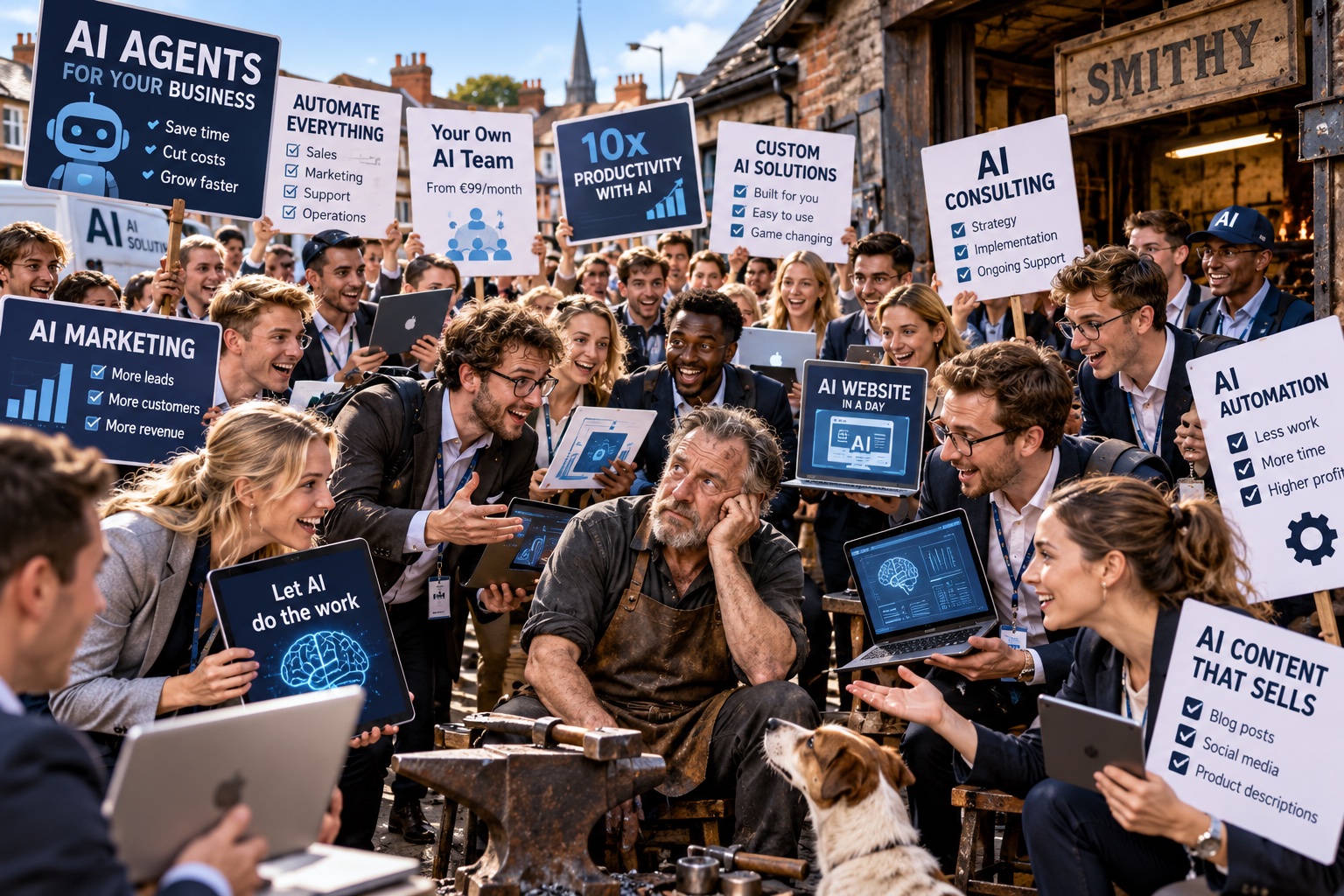
We have made it incredibly easy to create new products. We have not made it equally easy to create new customers.
And I suspect we may be underestimating the consequences.
Apparently, Everyone Is an AI Consultant Now
If I open Facebook or YouTube, the world appears to have undergone a remarkable transformation.
Everybody is building AI agents. Everybody has discovered a revolutionary business model. And everybody seems to have developed a solution that will transform your company, eliminate your administrative work and increase productivity by at least 300%.
Preferably before lunch.
For a brief moment, I almost started believing that the entire business community was working with AI. Then I remembered something.
My social media algorithms know exactly what interests me. They have been feeding me an increasingly concentrated diet of AI entrepreneurs, AI consultants and AI success stories.
Outside that bubble, the world looks rather different.
Meanwhile, the Local Blacksmith Has a Business to Run
Recently, I helped an old friend organize a complicated collection of emails, documents and messages using ChatGPT. It involved installation, configuration, sorting information and explaining how the various tools could work together.
I spent roughly 20 hours helping him. And I seriously doubt he could have completed the process independently.
I have been actively exploring ChatGPT since its public launch in late 2022. More recently, desktop tools have taken its practical possibilities to an entirely new level. Even with that experience, getting everything to work properly has involved a considerable learning curve.
Now imagine the owner of a small engineering workshop, a cleaning company, a local garage or a traditional manufacturing business.
He has customers waiting, employees to manage, suppliers calling and invoices to send. How much time does he have to investigate the latest AI agent, compare subscription plans and work out which applications are genuinely useful?
Probably not very much. And that does not make him technologically backward.
He simply has a business to run.
An Extraordinary Supply of Solutions
This is where I see a potential problem developing.
AI has dramatically reduced the cost of creating software. Something that once required a development team, substantial financing and months of work can sometimes be prototyped by one person in a few days.
That is an extraordinary development. But it also means that hundreds of entrepreneurs can arrive at very similar business ideas almost simultaneously.
The barriers to entering the market are falling. The number of potential suppliers is growing. But what about the customers?
They still have limited budgets, limited attention and a limited appetite for introducing new systems into their businesses. And every new application requires something from them: time, understanding, trust and often another subscription.
Eventually, even a genuinely useful product becomes just one more thing demanding attention.
We may soon have more AI solutions competing for attention than customers willing to investigate them.
Not because the solutions are necessarily bad. But because the market cannot absorb an unlimited number of competing propositions at the same speed they can now be created.
And Then the Feature Becomes Standard
There is another problem. Imagine spending a year developing an impressive AI application. You launch it, attract your first customers and begin building a business.
Six months later, a similar capability appears as a standard feature in ChatGPT, Microsoft or another major platform. Suddenly, the technology that made your business special is no longer particularly special.
Of course, specialized software can still have considerable value. Integration, reliability, security, industry knowledge and customer support do not disappear simply because a large platform introduces a new feature.
But an impressive demonstration is not the same thing as a sustainable competitive advantage. And an ingenious product is not necessarily a viable business.
We have seen versions of this story before. The difference is that AI may compress the entire cycle into months rather than years.
The Customer Is Becoming More Difficult to Convince
There is also a growing trust problem. When the market is flooded with extraordinary promises, exaggerated demonstrations and occasional outright scams, customers become increasingly skeptical.
That skepticism is not necessarily irrational. It may be the most sensible response to an overwhelming number of offers.
Imagine being approached by five different consultants, each explaining that your company urgently needs a different AI solution.
One recommends an AI chatbot. Another suggests an AI agent. A third wants to automate your sales process. A fourth offers an AI visibility platform. And the fifth has developed something so revolutionary that he can barely explain what it does.
You might eventually conclude that the safest investment is to buy absolutely nothing. And get back to work.
Perhaps the Real Opportunity Is on the Customer's Side
This leads me to a rather different conclusion about the future AI market.
Perhaps we do not need quite so many companies inventing new AI products. Perhaps we need more people helping ordinary businesses understand what they actually need.
People who can distinguish between an impressive demonstration and a useful business solution. People who understand the customer's daily operations rather than simply the latest technology.
And people who are prepared to say: "You don't need to buy that. You already have a tool that can do most of it."
That may not be the most exciting sales pitch in the world. But it is an excellent way to establish trust.
And trust could become one of the most valuable competitive advantages in a market overflowing with products that are increasingly easy to copy.
Preparing for What Comes Next
At Waltham, this is precisely the changing market we are trying to position ourselves for – and one we hope to help other businesses prepare for as well.
Not simply by identifying what AI makes possible today, but by asking a more fundamental question:
What will make customers choose your business two years from now, when today's extraordinary technology has become ordinary?
That is a strategic question worth considering before investing heavily in the next brilliant idea.
New technology will continue to create opportunities. Some will be highly profitable, others remarkably short-lived.
The challenge is to capture the opportunities available today while building the reputation, relationships and capabilities that will still matter tomorrow.
Because being early is an advantage. Remaining relevant is a business strategy.
A Question Worth Asking
I am certainly not predicting the end of the AI industry. Quite the opposite. I expect AI to create enormous economic value and entirely new industries.
But I suspect a significant number of today's promising AI companies will struggle to find enough paying customers. Not because they lack innovation. Not because their founders are incompetent. But because the supply of new ideas may be growing much faster than customers' ability and willingness to adopt them.
After 25 years in market research, I have learned to respect one rather fundamental distinction:
What businesses are capable of selling and what customers actually want to buy are not necessarily the same thing.
And in the age of AI, that distinction may become more important than ever.
We certainly won't run out of brilliant ideas.
The more interesting question is whether we'll run out of people who want to hear another pitch about them.
Waltham Consulting | Market Research · Business Development · AI & Digital Reputation