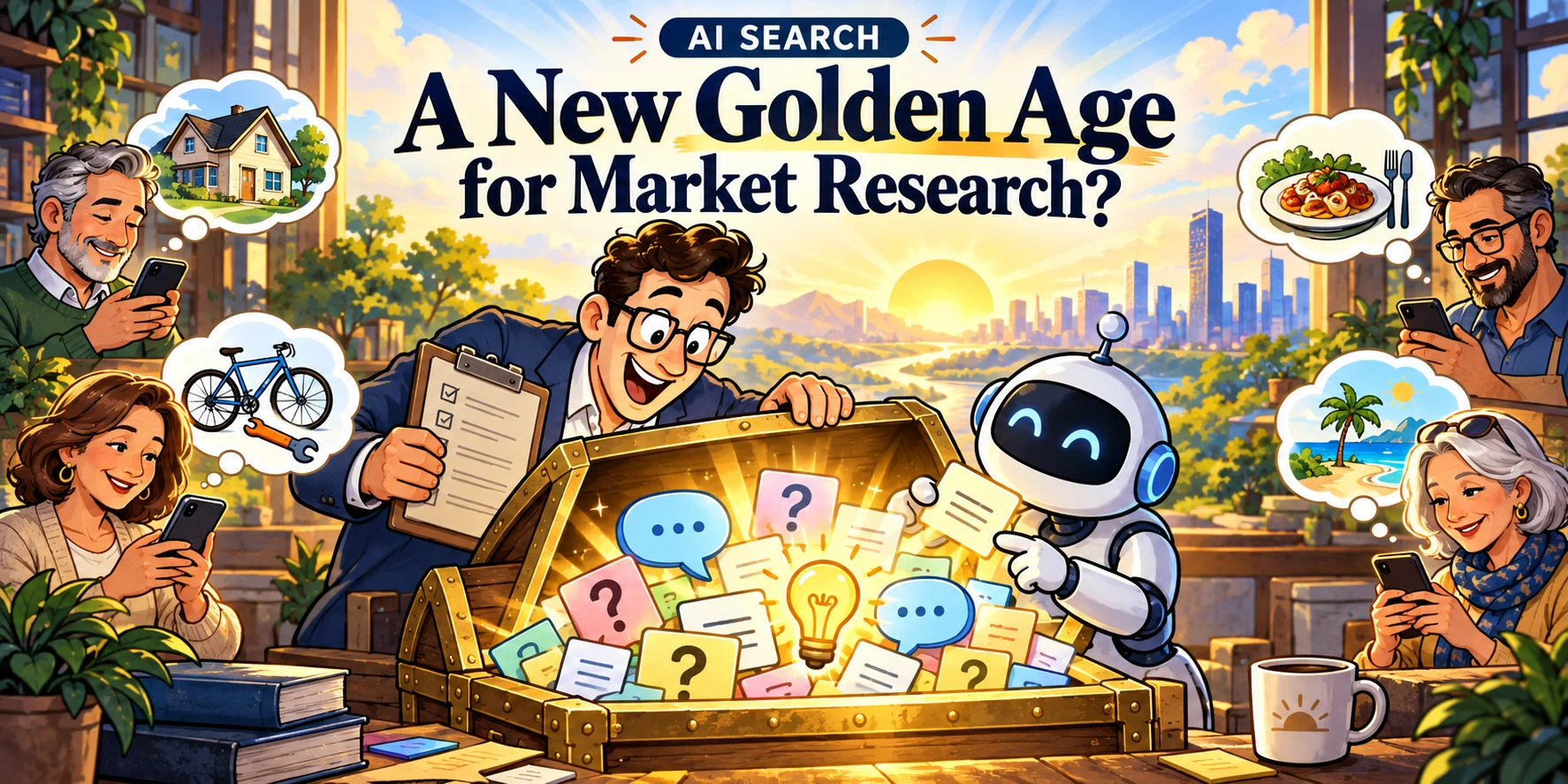
I spent more than 25 years working with market research and opinion polling. Today, through our work with AI Visibility at Waltham Consulting, I find myself returning to a familiar question:
What really matters to the customer?
The question is familiar. The place where the answer matters is changing. A customer can now ask an AI assistant for advice before visiting a company’s website or speaking to a salesperson. That gives market research a new job: understanding the needs behind the conversation.
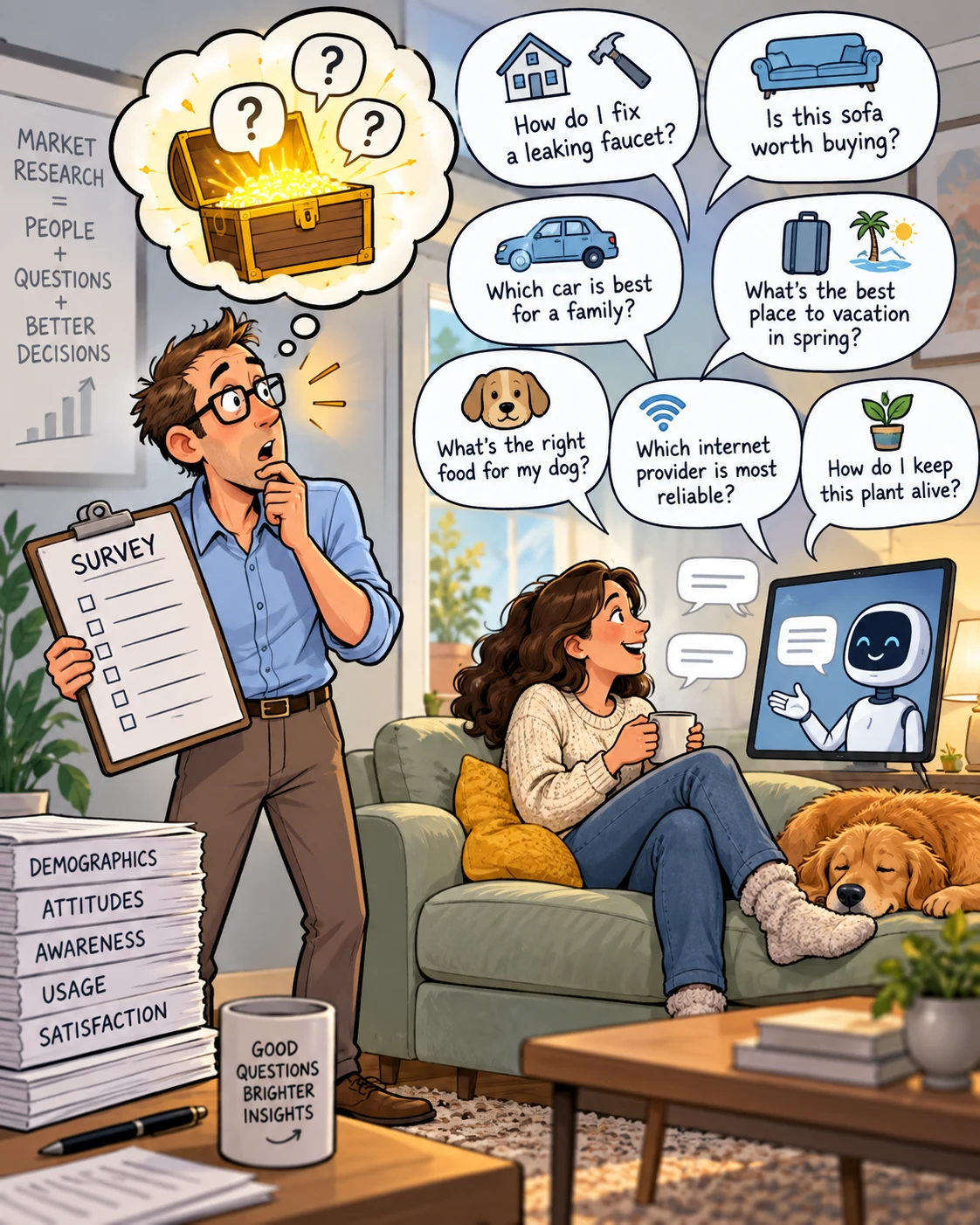
The customer has everyday problems. The researcher’s opportunity is to understand which questions matter — and what a useful answer must explain.
Start with a leaking roof
Imagine you need a new roof. You could search Google for “roofing company near me”. Or you could ask an AI assistant: “Who should replace my roof?”
Both routes can help you find a supplier. But the conversation gives you room to explain your worries: Will the house stay dry during the work? Can the original appearance be preserved? Who takes responsibility if something goes wrong?
Now imagine you have already discussed your house with the assistant. It may have relevant context about its age, your location or your renovation plans. You may not need to repeat the whole story.
This is already possible in systems such as ChatGPT when relevant memory features are enabled. What they remember and use depends on the product and settings. They do not remember everything, and they can misunderstand.
The important point: a short question can carry a much bigger brief.
Same question. Different people.
Think about asking a friend: “Where should I eat tonight?” A friend who knows you might suggest somewhere inexpensive. For somebody else, they might recommend a quiet restaurant serving local food. The words are the same. The needs are different.
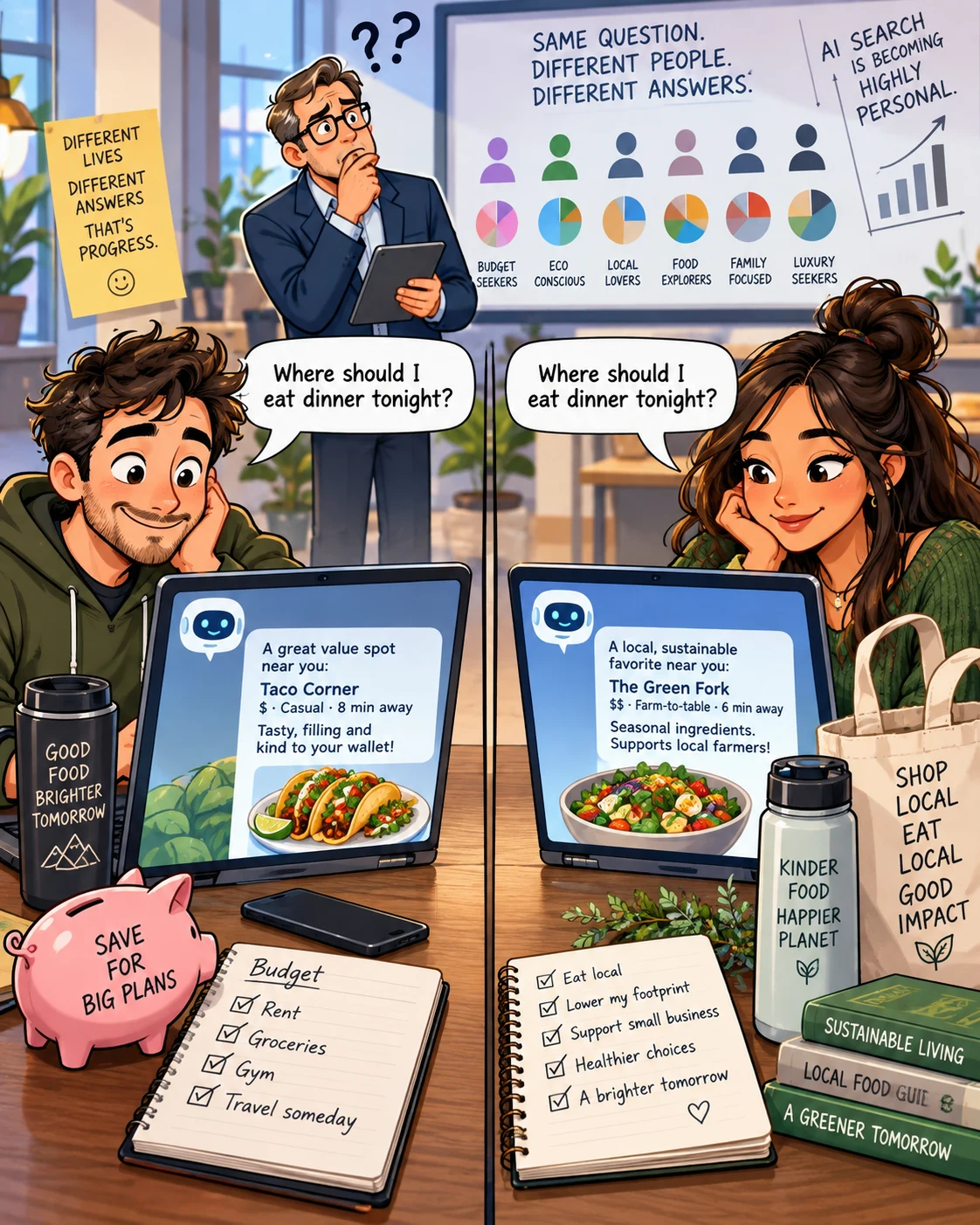
Both people ask where to eat. One values an affordable meal; the other values local, sustainable food. The illustration shows how personal context could make different recommendations useful. The restaurants are fictional.
An AI assistant can use relevant preferences in a similar way. That does not mean every answer is personalised or every recommendation is right. It means businesses need to think beyond the sentence typed into the chat.
Who is asking — and what would make a supplier a good fit for that person?
That sounds remarkably like market research
In our AI Visibility work at Waltham Consulting, one question keeps appearing: What will the customer actually ask the AI?
At first glance, that sounds like a question about search optimisation. In practice, it leads straight into customer research: needs, motivations, doubts, trust and the reasons people choose one supplier over another.
Researchers have spent decades studying these things. AI search gives that knowledge another practical use: helping companies explain their relevance before a customer ever contacts them.
The precise wording of a question is only part of the picture. Somebody asking for “the best roofer” may mean the cheapest, the most reliable, or the one most experienced with older houses. A useful conversation helps uncover the difference.
A company’s story may miss the customer’s worry
A company’s website might celebrate its advanced technology. The customer wants to know whether installation will disrupt the business.
The company might emphasise 30 years of experience. The customer wants to know who will answer the phone if there is a problem.
The company might focus on a competitive price. The customer wants reassurance that the quotation will not grow halfway through the job.
Those are research questions with communication consequences. Understanding them helps a business create explanations, articles and case stories that address real decisions.
Customer insight becomes useful evidence
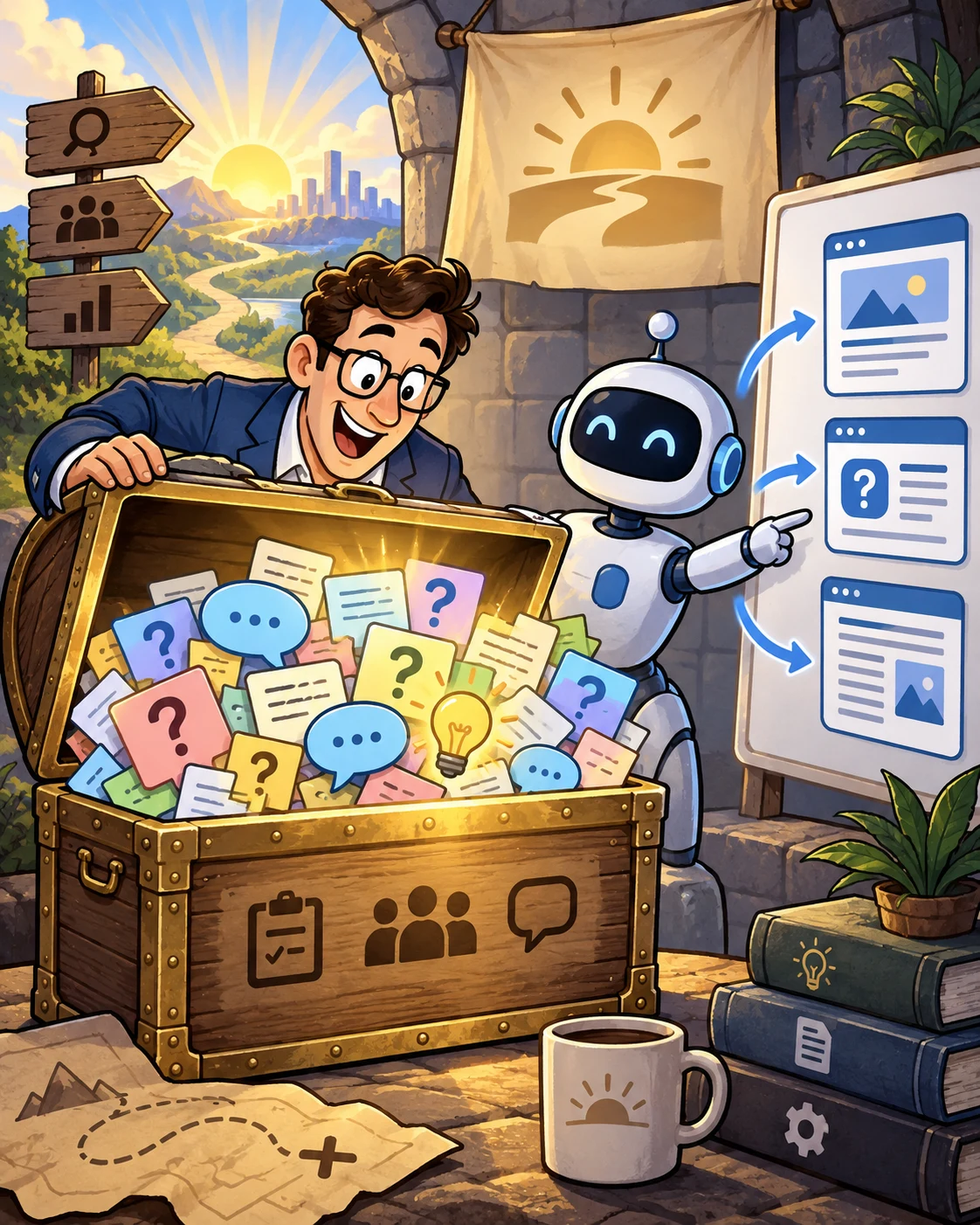
The treasure is customer understanding. Its value grows when it becomes clear, reliable information in articles, answers and real case stories that people — and AI systems — can use.
At Waltham Consulting, we are working at this intersection: connecting customer understanding with the information a business makes available online.
AI Visibility means helping a business become discoverable and accurately understood in AI-generated answers. Useful customer insight can guide what the business explains, while documented strengths and real examples give those explanations substance.
A roofing company experienced in preserving older houses should make that expertise easy to understand and verify. A bicycle workshop that repairs rather than replaces parts should explain when that approach is suitable.
This gives an assistant better evidence to assess relevance. It does not guarantee a recommendation. Customer insight guides the message; genuine capability supports it.
A new golden age?
There is plenty of discussion about AI doing work that researchers used to do. My interest is in the new work it creates.
Businesses will still need to understand what customers value. They will also need to understand how those values shape conversations with AI — and whether their public information answers the questions that follow.
That is a substantial opportunity for market research. It brings a familiar discipline into a new part of the buying journey.
The next valuable research question may be: “What does an AI need to understand about our business to recognise when we are a good fit?”
Answering it starts with understanding people. And that is a craft our industry already knows well.
AI Visibility is still an emerging field. At Waltham Consulting, we are looking for like-minded people who would enjoy helping develop new products and services — a shared effort built on curiosity, practical experience and different perspectives. If that interests you, I would be glad to hear from you.