
A new generation of AI infrastructure is on its way — and its most important effect may be economic.
We may be entering an era in which advanced artificial intelligence becomes not only more powerful, but dramatically cheaper to use. The name worth remembering is Vera Rubin.
Vera Rubin is NVIDIA's next integrated platform for large AI systems. It is not simply a new GPU. Processing, memory, networking, storage and software have been designed to operate as one machine. Think of it as replacing the engine, the power supply and the road network at the same time.
Three figures explain the leap
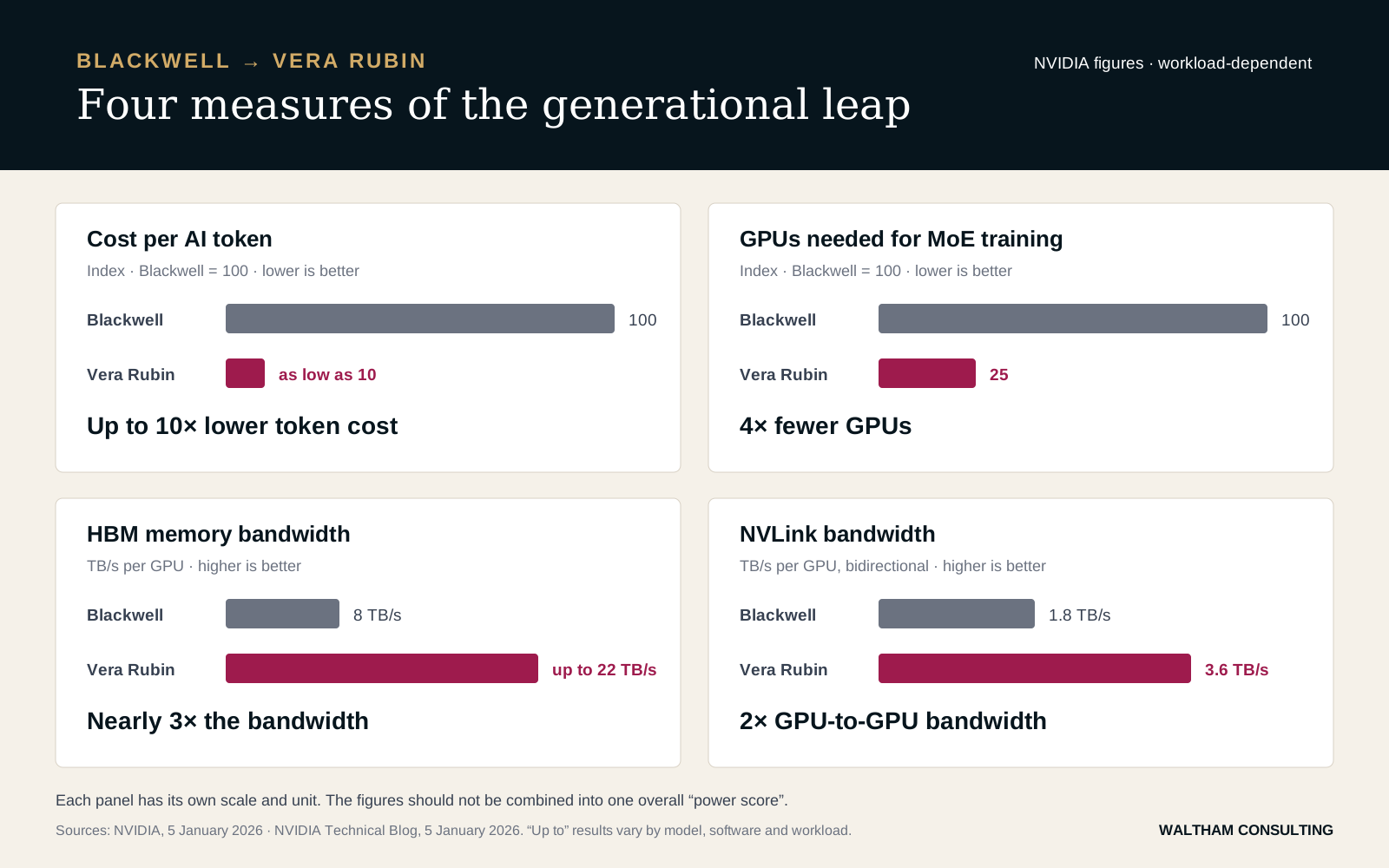
These are large numbers, but they need to be read correctly. They do not mean that every kind of AI automatically becomes ten times better. Results depend on the model, workload, software and system configuration. The important signal is the direction: more AI work per dollar and per watt.
Named after a woman who saw the invisible
The platform is named after American astronomer Vera Rubin. In the 1970s, her observations of spiral galaxies showed that stars moved in a way visible matter could not explain. Her work provided crucial evidence for dark matter.
The name is almost poetic. Vera Rubin made an invisible force apparent through its effects. The AI platform may also have its greatest impact somewhere we do not see directly: in the price of intelligence.
The most important news may not be that AI is becoming more powerful. It is that more of that power could become economically accessible.
What does cheaper intelligence mean for business?
When cost falls, it becomes practical to let AI spend longer on a task. It can review more material, test more options, generate video and other compute-heavy content, and run agents that complete work across several steps.
- More organisations can use advanced models in daily operations.
- Products can include more intelligent assistance without the same cost per user.
- AI agents can spend time researching, checking and improving their work.
- Competition may shift from who can access the capacity to who uses it best.
This is not a reason to wait
Businesses do not need to buy a Vera Rubin system or pause development until the technology is widely available. The relevant work can begin now: organise the data, select specific workflows, build experience and decide where human oversight is necessary.
Cheaper compute does not solve an unclear problem. It simply makes both good and bad uses easier to scale.
So the strategic question is not only: How powerful will the next generation of AI become?
It is: What will we do when that power becomes affordable enough for almost everyone to use?
Sources: NVIDIA: the Rubin platform, NVIDIA: technical platform overview, NVIDIA: early MLPerf results and NASA: Vera Rubin and dark matter. Results and savings are workload-dependent; the platform figures are published by NVIDIA.