Recently, I had a customer-service experience that made me think again about the rush towards AI call centres.
I had a fairly simple problem with a large online provider. It should have been resolved quickly.
Instead, there was a chat. Then another chat. Emails. Logins. Incorrect passwords. Codes. New attempts. More messages.
This continued for days. I must have made 20 or 30 attempts through chat, email and automated processes.
Then the phone rang.
A human being.
A friendly employee listened, understood the problem and began to help. Almost immediately, the frustration disappeared.
What struck me afterwards was how strange the whole journey had been.
We spend heavily to make customers contact us
Companies spend substantial amounts on advertising, search, social media, SEO, AI visibility and lead generation.
All of it is designed to persuade a person to do one thing: make contact.
And then it happens. The customer writes. Or, more deliberately, picks up the phone and calls.
That is one of the most valuable moments in business. A person has actively chosen to speak to the company.
Yet this is exactly where many companies start building barriers.
AI on the phone can make perfect sense
I understand why AI call centres and virtual receptionists are growing.
The technology can answer around the clock, handle routine questions, collect information, book appointments, find an order and route a call. For high-volume, predictable enquiries, that can be genuinely useful for both the customer and the company.
But a system that can hold a conversation is not necessarily a system that understands when the conversation should end.
The better question may not be: How can AI take over customer contact?
It may be: How can AI make the person speaking with the customer much better?
Transparency is now part of the experience
There is also a timely change in Europe. Since 2 August 2026, Article 50 of the EU AI Act has applied transparency obligations to certain AI systems that interact directly with people. In practical terms, people should be told when they are interacting with AI unless it is obvious.
That is a sensible minimum. A caller should not have to guess whether the warm, patient voice on the line belongs to a person or a machine.
But disclosure alone does not create trust. Saying “I am an AI assistant” is only the beginning. The system must also make it easy to reach a person when the situation becomes complicated, emotional, unusual or commercially important.
The quality of an AI receptionist may therefore be judged less by how convincingly it imitates a human and more by how responsibly it knows its limits.
A phone call is more than a support task
If customer service is treated only as a cost, automation looks entirely logical. Fewer people means lower operating costs.
But a phone call can be the start of a relationship.
A good employee hears things that never appear in a CRM field: doubt, humour, irritation, interest, uncertainty and opportunity.
A person can ask one more question. Notice a hesitation. Understand that the customer's real problem may be different from the one they first described.
Sometimes that is where loyalty is created. Sometimes it is where a sale begins. And sometimes it is where a company learns that one of its processes is broken.
If AI contains every call inside a scripted flow, the business may save time while losing the very signals it needs to improve.
The most useful model may be a combination
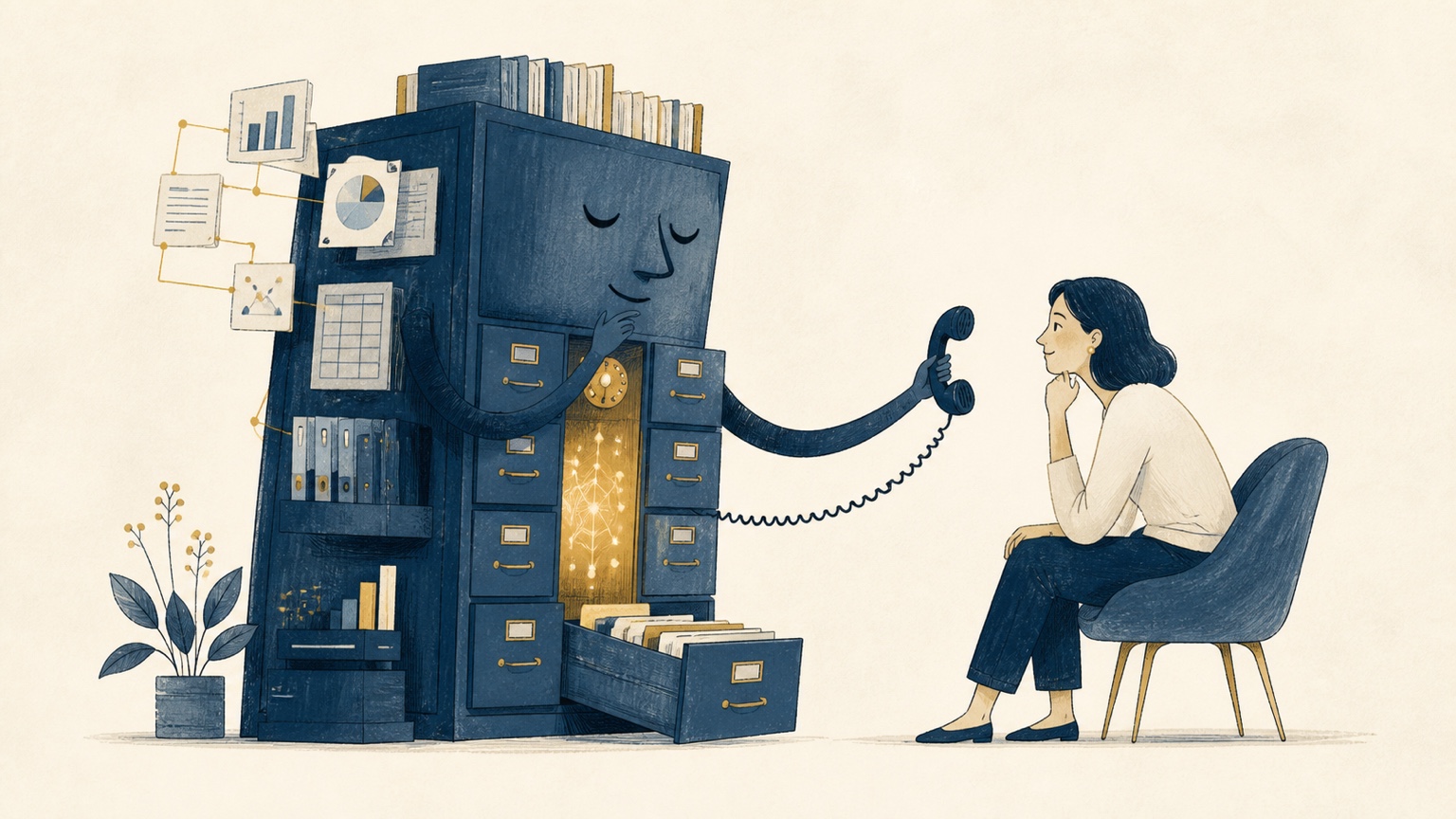
Imagine that a person answers the phone while AI works quietly in the background.
When the customer calls, AI can bring together:
- customer history
- previous enquiries
- relevant products
- current prices
- open cases
- invoices
- appointments
- useful documentation
During the conversation, it can help the employee find information and suggest the next best question.
Afterwards, it can:
- prepare a summary
- update the CRM
- draft the follow-up email
- create tasks
- document agreements
- route information internally
The customer still speaks with a person. But that person has a powerful digital assistant beside them.
To me, that is a more interesting use of AI than simply replacing the voice at the other end of the line.
Every automated conversation needs an escape hatch
There will still be calls that AI should handle from beginning to end. Opening hours, delivery status, appointment changes and simple information requests are obvious candidates.
The design question is what happens when the request stops being routine.
A good system should recognise repetition, uncertainty, frustration, vulnerability and risk. It should not force the caller to repeat the whole story after a transfer. It should pass the context to the employee and make clear what has already been tried.
The handover should feel like progress, not like starting again.
This also changes what the company should measure. Containment rate and cost per call matter, but they are not enough. We should also look at first-contact resolution, repeat contacts, time to a useful human handover, customer effort and what the company learned from the conversation.
If an automated system keeps a caller occupied for ten minutes and the person still has to call again, it has not really saved anyone time.
Human contact can become a competitive advantage
The more the world automates, the more valuable genuine human contact may become.
We already see companies where it is almost impossible to find a telephone number. When you finally find one, another system is waiting.
That makes a very simple promise surprisingly powerful:
Call us. A person will answer.
It sounds old-fashioned.
Perhaps it is about to become modern again.
Do not automate the relationship by accident
The choice is not between people and AI. It is about using each where it is strongest.
AI is excellent at routine work, retrieval, documentation, analysis and administration. People remain strong at relationships, judgement, trust and understanding the situation around the words.
The practical question is not whether AI can answer the phone.
It can.
The question is whether answering the phone is the part of the relationship we should automate.
Let the person handle the relationship.
Let AI handle the work around it.
Regulatory note: The European Commission's guidance on Article 50 explains that people must be informed from the start when they are interacting directly with an AI system, unless the interaction is obvious. Read the Commission's guidance.