Artificial intelligence is becoming more widely available. Access to the technology, actual use and the value derived from it are three distinct things.
That distinction matters when assessing AI’s economic and social significance.
On 5 November 2026, the OECD published its OECD Digital Economy and Society Outlook 2026. The report documents substantial differences in AI use across age groups and businesses of different sizes.
Developments in the technology could make these differences more consequential. AI assistants can increasingly answer questions from material users supply and, with permission, find, analyse and cross-reference information in existing digital systems.
That changes both the potential benefits and the assessment of risk.
Wide differences in AI adoption
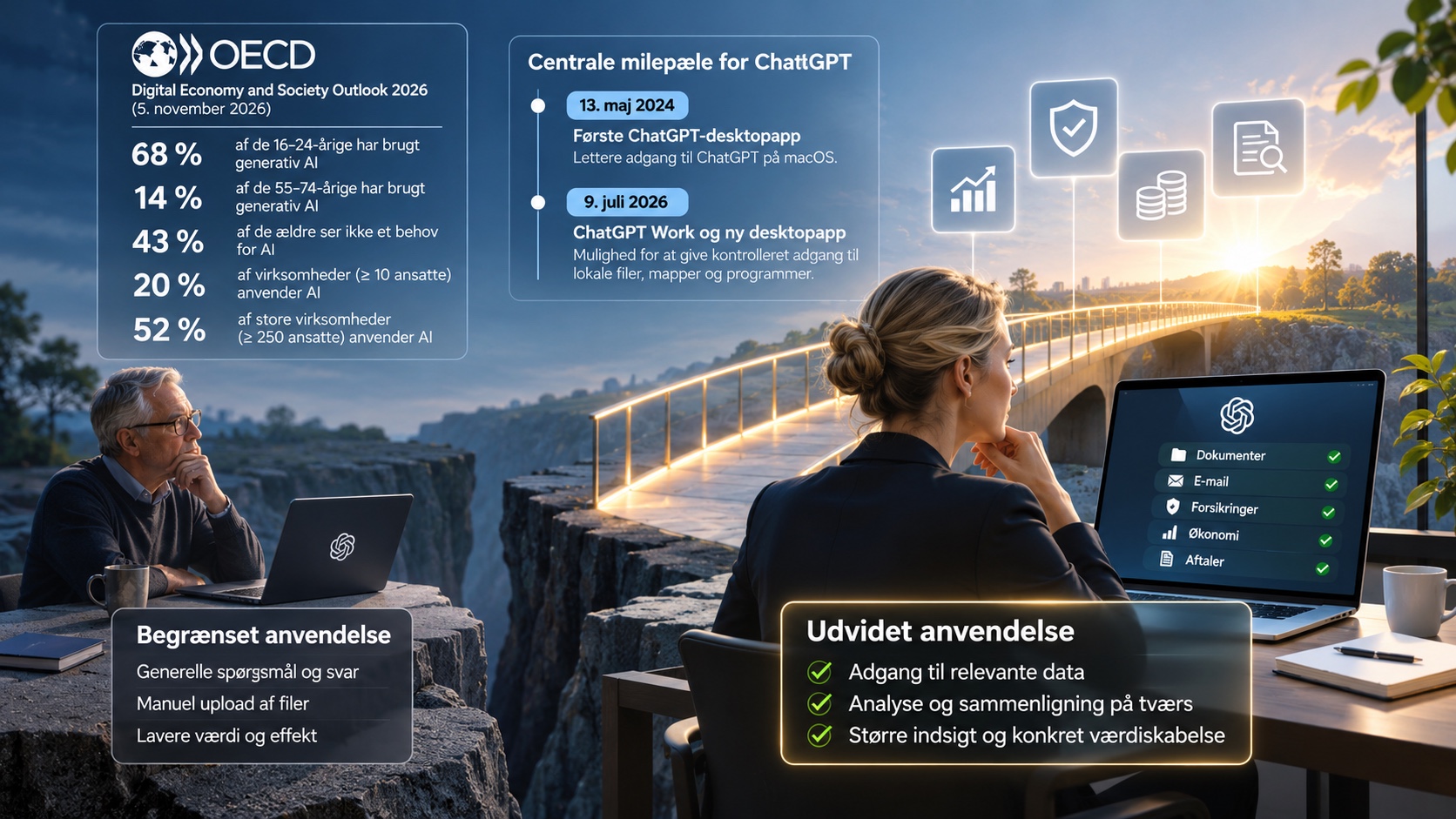
The OECD reports that around 37% of people aged 16 to 74 had used generative AI in the previous three months, based on data for 2025 or the latest available year.
Use varies widely by age.
- 68% of 16- to 24-year-olds had used generative AI.
- 14% of 55- to 74-year-olds had done so.
- 43% of older adults reported seeing no need for AI.
- 12% of older adults cited a lack of skills.
Adoption also varies considerably among businesses. The OECD estimates that 20% of enterprises with at least ten employees used AI in 2025. Among large enterprises with at least 250 employees, the figure was 52%.
The OECD identifies barriers including a lack of skills, implementation costs and difficulties integrating AI into existing systems.
The figures document differences in adoption. They tell us much less about how effectively the technology is used.
Occasional use of AI to draft text differs considerably from systematic integration into administrative and analytical workflows. The potential value differs too.
From manual document analysis to access to local files
The development of ChatGPT illustrates this shift.
18 May 2023. OpenAI launched the first ChatGPT app for iPhone, with the initial rollout in the United States.
13 May 2024. OpenAI announced its first ChatGPT desktop app and began rolling it out to Plus users on macOS. Keyboard shortcuts, voice and screenshots made it easier to use ChatGPT from a computer.
Users could already have documents analysed by providing the files themselves or using integrations available to them.
9 July 2026. OpenAI introduced ChatGPT Work and a new desktop app for macOS and Windows.
OpenAI says Work in the desktop app can use local files and applications with the user’s permission, where their plan and workspace settings allow it.
ChatGPT could already connect to external data sources. The ability to work with approved local files expanded its practical uses. Users often had to find the right information before asking AI to analyse it. An assistant can now also help locate that information within the access it has been granted.
The main shift is from supplying information manually to granting controlled access to existing sources.
That change could affect how individuals and businesses use AI.
Access to information is essential to well-founded answers
A review of personal insurance cover provides a concrete example. An AI assistant can review policy documents, compare terms and flag possible overlaps or gaps in cover.
A reliable, comprehensive review may require much more than the latest policy. Relevant information may be spread across older documents, notices of changes, correspondence, payment records and individual agreements.
Without those sources, even an advanced AI model may work from an incomplete picture. The quality of the answer depends both on the model’s ability to analyse the material and on the information available to it.
Connecting the relevant sources may be manageable for technically experienced users and a substantial barrier for others. Two people using the same model can therefore get very different practical results.
Weighing the risks and benefits of granting access
The ability to grant access to more sources raises questions about information security and privacy. The assessment should start with what access entails in practice.
When an AI service is authorised to analyse documents, it can use them within the scope of the access it has been given. How the information is handled depends on the service and its applicable terms.
- What information can the service access?
- How is the information processed and stored?
- What safeguards protect that access?
- Can the assistant only read the information, or can it also modify it and take actions?
OpenAI says messages and task context may be stored in the cloud even when a Work task runs locally. The assessment should therefore consider the specific permissions, data processing terms and safeguards in place.
Different kinds of information carry different risks
| Type of access | Potential value | Main risks |
|---|---|---|
| Historical documents and receipts | Search, record-keeping and financial oversight | May contain sensitive information |
| Email and correspondence | Agreement history, obligations and context | Private and confidential information |
| Insurance and tax documents | Analysis, comparison and identification of discrepancies | Financial and sensitive personal information |
| Financial systems with read-only access | Financial analysis and oversight | Extensive visibility into financial affairs |
| Systems with permission to modify records or carry out transactions | Automation of actions | Erroneous or unauthorised actions |
Risk depends on the type of document, the scope of access, the security of the system and the consequences of any misuse.
Two-factor authentication can make it harder to take over an account if its password is compromised. The handling of information and the use of already authorised connections need separate assessment. The distinction between read-only access and permission to make changes or carry out transactions is particularly important.
The risk of leaving information unused
Security discussions often focus on what can go wrong when a technology is used. An economic assessment should also consider what may be missed by leaving it unused.
Individuals and businesses often hold information that receives little review or analysis. Examples include
- insurance policies with overlapping cover
- supplier contracts with unfavourable terms
- undetected billing errors
- subscriptions and ongoing financial commitments
- agreements that are due for renegotiation
AI could reduce the cost of reviewing and cross-referencing this information. The quality of the analysis and the amount of information the service needs have to be assessed for each task.
Choosing to forgo the technology can carry risks of its own.
Those risks belong in the assessment alongside the risks of using it.
A new dimension of digital inequality
The OECD documents substantial differences in AI use across age groups and businesses of different sizes. Developments in the technology point to another distinction that could matter.
Some people use AI as a standalone tool for questions and analysis, drawing on the model’s general knowledge and material they supply. Others connect it to their own sources and can obtain analyses grounded in their documents, historical data and business context.
That could create differences in productivity and in the information people rely on to make decisions. The scale of those differences is still unclear. This is Waltham’s hypothesis about future developments. The OECD study measures differences in adoption.
From AI literacy to information literacy
Much of the debate about AI has focused on whether people have the skills to use it. Those skills will remain important. Access to information may become at least as important.
That involves both the ability to connect systems and the willingness to grant access. Businesses will need to acquire suitable AI tools and ensure that their information is structured, accessible and can be used with appropriate safeguards.
For individuals, the challenge is to gain comparable access to assistance without having to manage a complex technical setup.
That raises a new question about digital inclusion. Will advanced AI mainly benefit people and businesses that already have strong digital capabilities? Or will more people be able to obtain the same kind of well-informed assistance?
Conclusion
The latest OECD figures show that AI adoption remains highly uneven. At the same time, desktop AI assistants can bring the technology closer to existing workflows and sources of information.
That combination could have significant implications for digital inequality. Who uses and understands AI will continue to matter. Increasingly, so might who is equipped to give AI secure, controlled and relevant access to the information that creates value.
Technological development, information security, trust and economic productivity meet here. The trade-off between risks and benefits deserves more concrete discussion.
Sources
- OECD (5 November 2026) · OECD Digital Economy and Society Outlook 2026
- OECD (5 November 2026) · AI adoption accelerates across the OECD, but major gaps persist among businesses and generations
- OpenAI (18 May 2023) · Introducing the ChatGPT app for iOS
- OpenAI (13 May 2024) · Introducing GPT-4o and more tools to ChatGPT free users
- OpenAI (9 July 2026) · ChatGPT release notes
- OpenAI · ChatGPT Work and Codex
- CISA (October 2022) · Implementing Phishing-Resistant MFA