By Nikolai Waltham · 1 November 2026
Can you write a city richer?
What happens if you study the business community of an entire municipality and share what you discover? Nyborg Business Atlas is an open experiment in turning knowledge into opportunities.
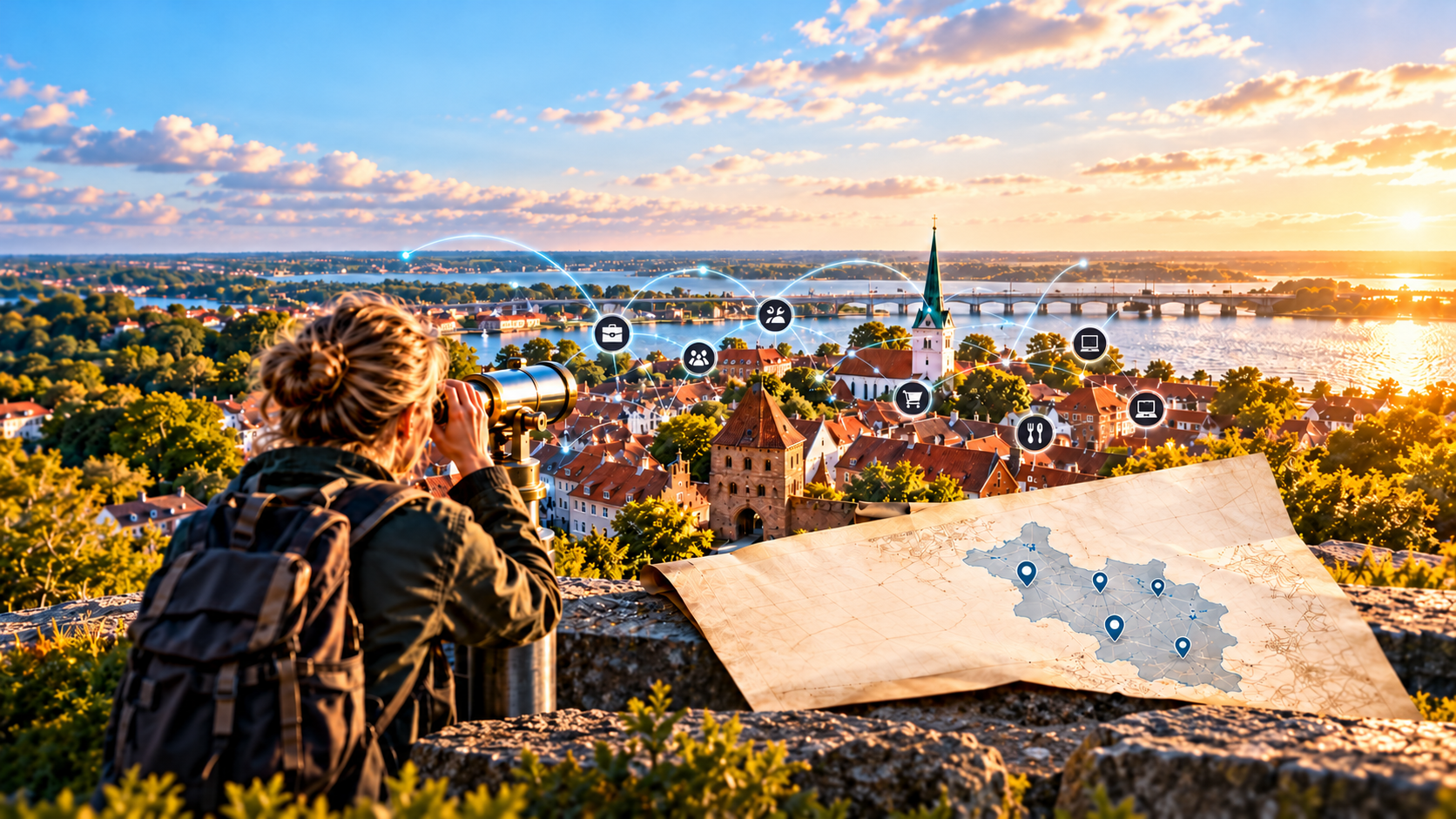
A business can be better at its work than its website suggests.
It may have solved difficult problems for years. It may have specialist knowledge its customers value. It may offer something other businesses are looking for.
But if nobody outside its immediate circle knows this, the opportunities may be smaller than they could be.
Imagine the same situation across a town. Businesses searching for help that may already be available nearby. Customers struggling to understand the differences between offers. Useful knowledge remaining scattered and disconnected.
That raises an interesting question:
Can we create more value by making what already exists easier to discover and understand?
That is what we want to investigate with Nyborg Business Atlas.
A town as a shared learning project
We are starting in Nyborg Municipality, Denmark.
We want to investigate patterns in businesses’ digital presence: How do they describe their offers? How clearly do they explain whom they help? Which information makes it easier for a customer to find a relevant supplier?
We use publicly available information and systematic research. Observations must be checked, and source terms must be respected.
This is a research and learning pilot. We have questions and a direction. We do not yet have a completed local analysis that answers them.
Nyborg is the starting point. Our ambition is to develop a method that can later be used in other municipalities and across Denmark.
Long-standing curiosity. New possibilities.
The idea grows out of my many years working in market research and opinion polling, including through InFact. The underlying question has always been the same: What can we discover when we investigate a market systematically instead of simply guessing?
Recent developments in AI create opportunities to review and connect information in ways that previously required far more manual work. This makes it interesting to study an entire municipality’s business community and look for patterns that might otherwise be overlooked.
New tools do not replace professional judgement. Sources must be checked, observations verified and uncertainties explained. Nyborg Business Atlas is an attempt to connect that research experience with these new possibilities.
The marketplace has a new guide
Imagine the town’s businesses as stalls in a marketplace.
Behind the stalls are people with experience, expertise and something to offer. But the customer may not know their names. They may only know which problem they need to solve.
‘Who can help with this particular task?’
That question can be put to a friend, a search engine or an AI assistant.
Whichever route they take, customers need concrete information: What does the business offer? Whom does it help? Where does it work? What supports the claims it makes?
A website promising ‘quality and good service’ provides only a small part of the answer.
That does not mean the business lacks quality. It may mean it has not yet explained its value clearly enough.
No business should be singled out
Nyborg Business Atlas should share knowledge that others can use.
All published atlas findings must be anonymous, aggregated and non-identifying.
We do not publish grades, rankings or assessments of named businesses. We also protect against indirect identification through small groups, distinctive combinations or recognisable examples.
When we publish a finding, readers should be able to see its basis, the period it covers and the uncertainties involved.
Missing information on a website is never, by itself, evidence of missing expertise.
Knowledge you can use today
An analysis becomes more useful when it gives readers an idea they can act on.
The atlas will therefore combine research with free advice, examples and small exercises.
You can start now: Find one sentence on your website that could just as easily appear on a competitor’s site. Replace it with a concrete explanation of whom you help and which task you solve.
A fictional example: ‘We deliver quality and personal service’ could become ‘We help small trade businesses on Funen with bookkeeping, payroll and VAT.’
The new wording must, of course, be true. But it gives the reader something more precise to assess.
But will the town become richer?
We do not know.
An article is not an order. A share is not a new customer. A new connection is not necessarily a profitable collaboration.
We will follow whether shared knowledge leads to relevant conversations, corrections, coverage and documented connections. Any later economic outcomes must be investigated separately. We will also report if little happens.
The hypothesis is still worth testing: If more people understand what is available around them, they may have better opportunities to use it.
Can you write a city richer? We will start by making it easier to understand.